
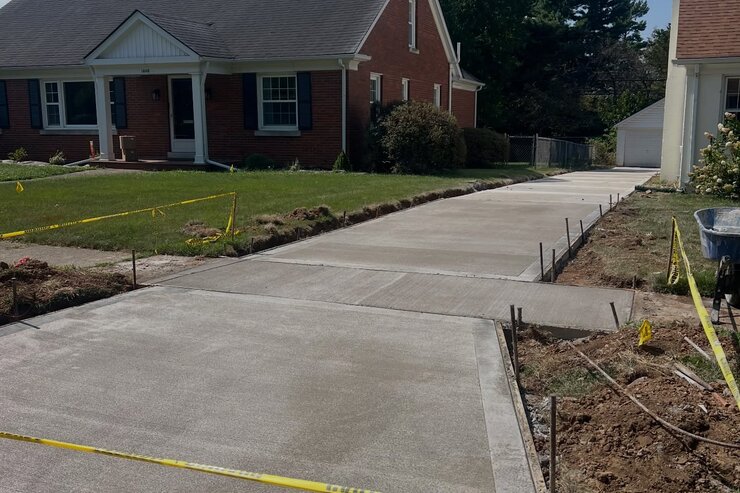
A sunken sidewalk panel looks like a job for a jackhammer — but you almost never have to replace settled concrete. If the slab itself is still solid, it can be lifted back to its original grade and the empty space beneath it filled, all in a couple of hours, for roughly half the price of tearing it out. This is concrete leveling, and for Providence's settled walkways, driveway approaches, and porch slabs it is usually the right answer.
Concrete does not sink because the concrete failed — it sinks because the ground underneath it gave way. A sidewalk is only as stable as its sub-base, and several things hollow that sub-base out over time. Water from a downspout or a poorly graded lawn washes the supporting soil away, leaving a void. Rhode Island's glacial till and dense clay compacts and consolidates after a wet season. Backfill around foundations and utility trenches that was never properly tamped settles years later. And when a tree root rots out, it leaves a soft pocket the slab eventually drops into.
Once a void forms, the unsupported slab tips toward the empty space, creating the low corner or dished section you see. The concrete is often perfectly intact — it has simply lost the floor beneath it. That distinction matters enormously, because a sound slab over a void is the textbook candidate for leveling rather than replacement.
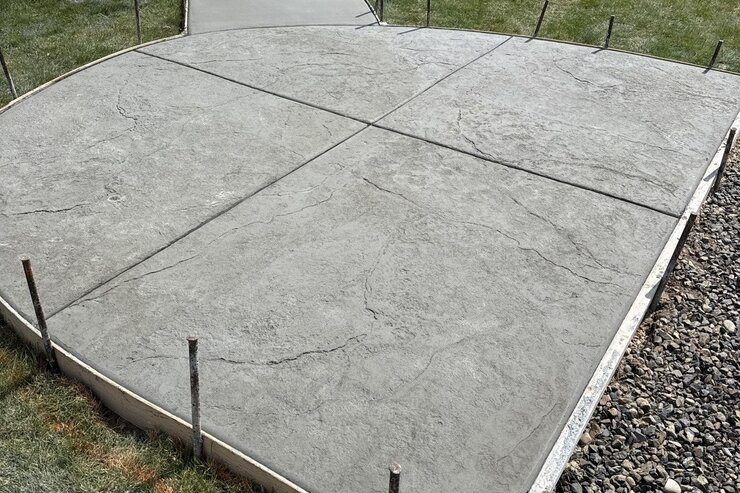
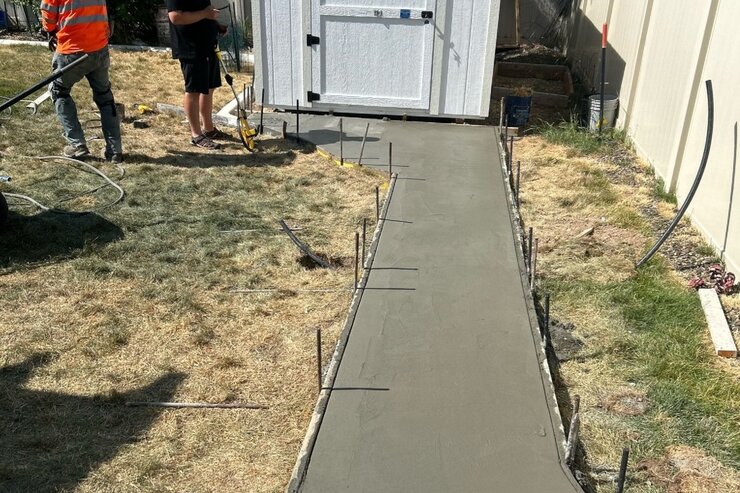
We drill a grid of small ports — about 5/8 inch for polyurethane foam or 1 to 1.6 inches for traditional mudjacking — through the sunken slab. Through those ports we inject material under pressure. Polyurethane is a closed-cell foam that expands and cures to a precise density, lifting the slab in millimeter increments while a crew member watches a laser level and calls the rise. Mudjacking, sometimes called slabjacking, pumps a flowable limestone-and-cement slurry that fills the void and floats the slab back to grade. Either way the empty space is filled and the panel is re-supported across its full footprint.
The two materials suit different jobs. Polyurethane foam weighs about four pounds per cubic foot, so it does not add load to an already weak sub-base, it is waterproof so it will not wash out in Providence's heavy spring rains, and it cures hard enough to walk on in about fifteen minutes. Mudjacking grout is far heavier but costs less per pound, which makes it the economical choice for very large or heavy slabs where weight is not a concern. We finish by patching the dime-to-quarter-sized injection holes with color-matched grout.
Replacing a sunken panel means demolishing perfectly good concrete, hauling it to a landfill, re-compacting the sub-base, forming, pouring, and then closing the walkway off for the better part of a week while the new slab cures. Leveling reuses the slab you already own. There is no demolition, no disposal, no week-long cure, and no mismatched white panel — the lifted concrete is the same concrete, just back where it belongs. For a homeowner that means the walk is usable the same afternoon.
Leveling is the correct fix when the slab is structurally sound — not crumbling, not cracked into several rocking pieces. We routinely raise panels up to four inches and have floated commercial pads as much as eight inches. If a slab is shattered or so thin it would crack under the lift, we will recommend replacement instead; pretending otherwise would just waste your money on a slab that fails again next winter.
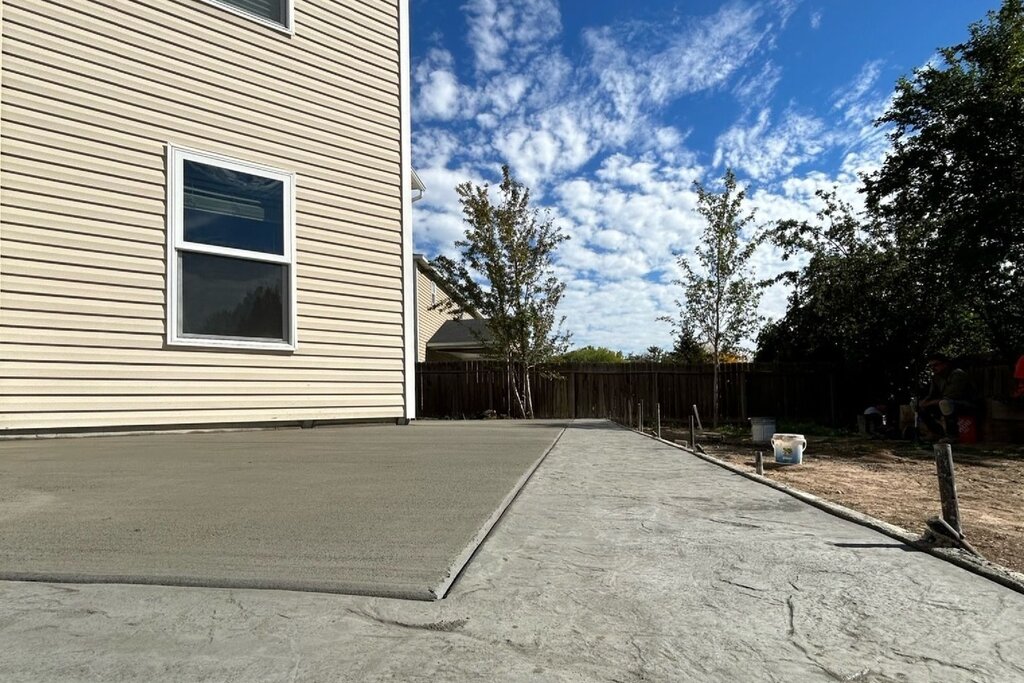
For a standard sunken section of Providence sidewalk, lifting the existing slab is dramatically cheaper and faster than replacing it. Here is a side-by-side for a typical residential panel:
| Typical sunken panel | Concrete Leveling | Full Replacement |
|---|---|---|
| Typical price | $400 – $1,200 | $900 – $2,000 |
| Demolition & disposal | None | Required |
| Time on site | 1 – 3 hours | 1 – 2 days |
| Usable again | ~30 minutes | 3 – 7 days |
| Keeps original slab | Yes | No |
Because leveling typically runs 50 to 60 percent less than replacement and skips the permit and disposal costs entirely, most Providence homeowners who came in expecting a teardown leave having spent a few hundred dollars instead of a few thousand.
Whether we use polyurethane foam or mudjacking, the sequence is the same and the slab is back in service the same day:
We run a dedicated polyurethane lifting truck and traditional mudjacking equipment, so we can recommend whichever method genuinely fits your slab instead of selling you whatever we happen to own. Every lift is guided by a laser level and backed by our 5-year workmanship warranty.
Got a sunken sidewalk, driveway apron, or porch slab in Providence? Before you pay for a teardown, let us see whether we can simply lift it. Call (401) 555-0148 or request a free estimate online and we'll be at your Providence-area property within two business days.